Market scout Report
Have to take into account this writing from Daily Speculations.
Have to take into account this writing from Daily Speculations.
Seems that my adapted put/call paritiy weighted strike price could work for fundamental events.
Yesterday in Corn:

And today (record crop):


Dado que todavia no se han popularizado las televisiones 3D y mucho menos los 3D-DVD, Avatar no tiene sustitutos por lo que tanta publicidad ha generado curiosidad que solamente se puede tranquilizar pagando la entrada al cine.
Para seguir produciendo ganancias Hollywood tendrá que sacarle el jugo al 3D antes que la piratería tenga acceso.
Si esta hipotesis es cierta, ToyStory 3D tambien debería ser relativamente rentable.
pd Aunque los efectos estan buenos, no me gustó.


Espen Gaarder Haug & Nassim Nicholas Taleb
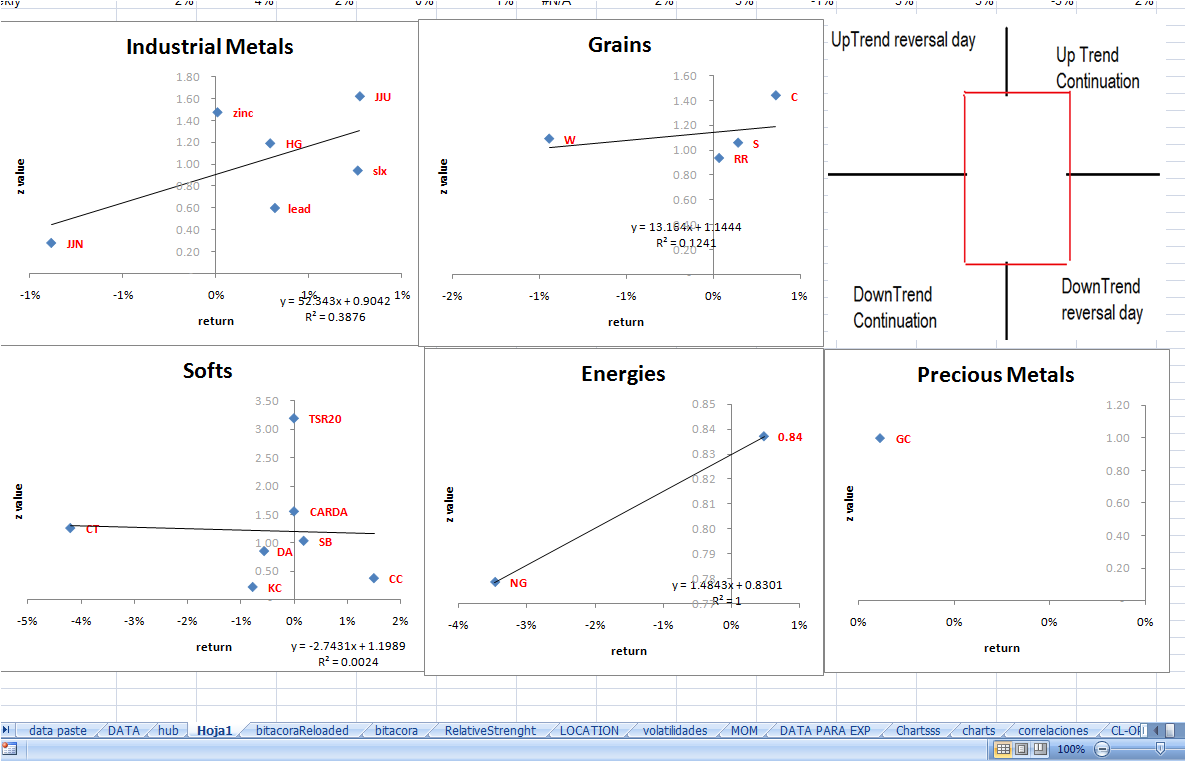
this print screen will serve me as a reference in the future regarding the steepness of the market and the day’s percentage return for the 2010 start.
The steepness of the mkt is measured by the z value of the last 67 days, meaning:
For the last 67 sessions please compare the average return with the normal volatility for a single day: average divided the result of dividing standard deviation in the square root of 67. If the result is grater than three, then the avg return is consistent because the normal growth is three times the usual volatility.
If I compare the 67-day resume against today’s return, then we can infer if we are in continuation, reversal or neutral activity according to the prevailing trend; like a strike zone as the one the upper right side red square.
I think this is a good method for discriminating what markets should be excluded from sight or maybe a pattern-report for building more abstract positions like selling volatility (inside the red strike zone) or getting other trend following positions for the ones outside the red square.
Back Testing it is the next step.

FROM : ARE FINANCIAL MARKETS EFFICIENT? p25
At the most general level, behavioral finance is the study of human fallibility in competitive markets. It does not simply deal with an observation that some people are stupid, confused, or biased. […] BF theory rest on two major foundations. The first is limited arbitrage, the second namely investor sentiment.
Limited arbitrage suggest that arbitrage in real world securities markets is far from perfect. many securities do not have perfect or even good substitutes, making arbitrage fundamentally risky and, even when good substitutes are available, arbitrage remains risky and limited because prices do not converge to fundamental values instantaneously. The fact that arbitrage is limited helps explain why prices do not necessarily react to non-information expressed in uniformed changes in demand. Limited arbitrage thus explains why markets may remain inefficient when perturbed by noise trader demands, but it does not tell us much about the exact form that inefficacy might take. For that, we need the 2nd foundation of behavioral finance: investor sentiment: the theory of how real world investors actually form their beliefs and valuations, and more generally their demands for securities. Combined with limite arbitrage, a theory of investor sentiment may help generate precise predictions about the behavior of security prices and returns.
if arbitrage is unlimited, then arbitrageurs accommodate informed shifts in demand as well as make sure that news is incorporated into prices quickly and correctly. Markets then remain efficient even when many investor are irrational.Without investors sentiment, the are no disturbances to efficient prices in the fist pace, and so prices do not deviate from efficiency. A behavioral theory thus requires both an irrational disturbance and limited arbitrage which does not counter.
During the last resting days I spent two weekends at the beach and I read The Daily Trading Coach and Fooled by randomness from NN Taleb.
Main ideas I will rewrite then:
> emotion and reasion [taleb]
> rationality, emotions and trading [taleb]
> what it takes to be a full time trader [brett]
> new tool to add at the jornal [brett]

